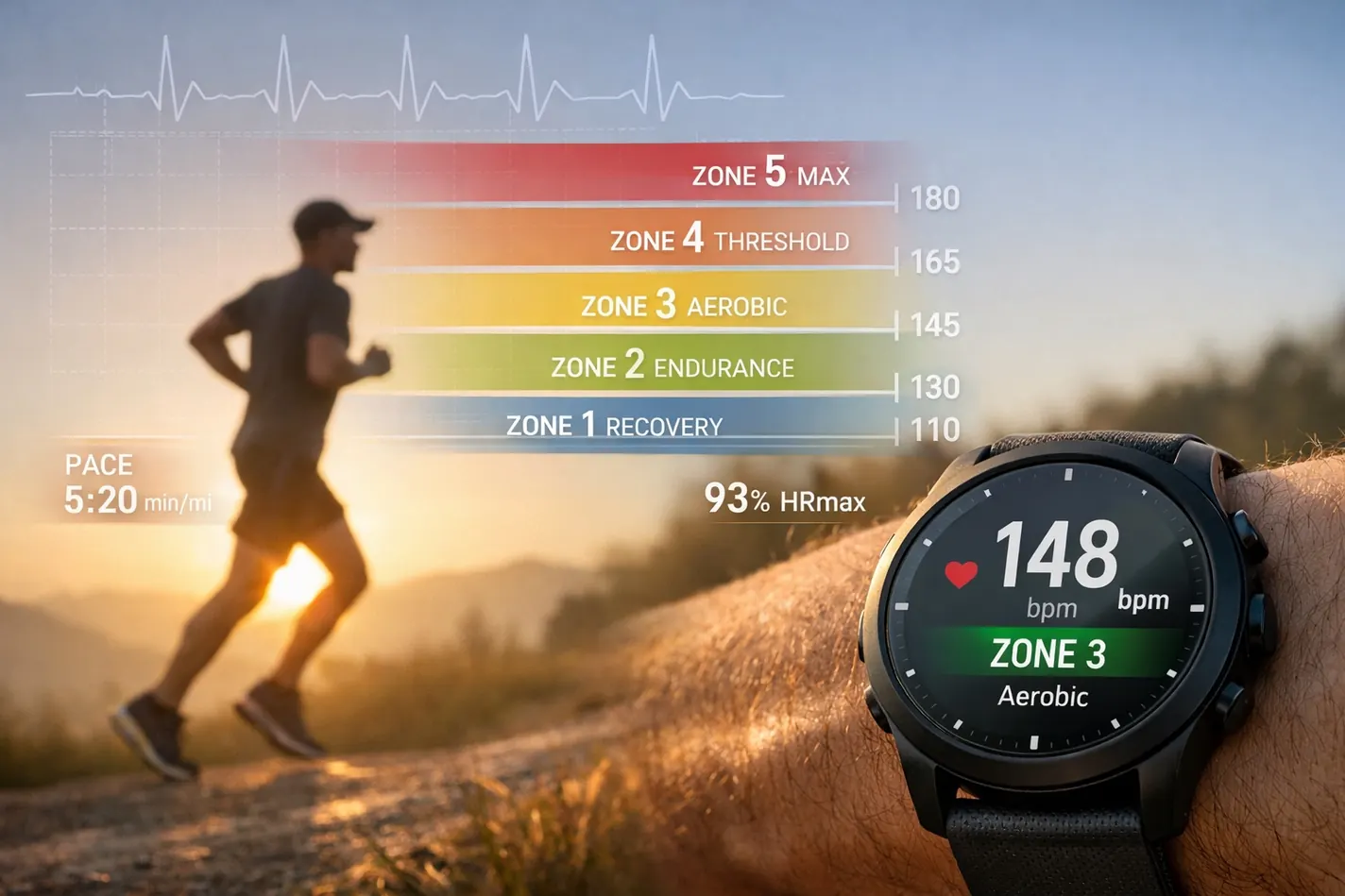
Heart rate is the single best indicator of what's happening inside your body during a run. Not pace, not speed, not how you feel – but your actual heart rate. If you train without monitoring it, you're running blind.
Why Heart Rate Training Works
Most recreational runners make the same mistake: they run too fast on easy days and too slow on hard days. The result? They spend most of their time stuck in a "gray zone" – too fast to recover, too slow to improve.
Heart rate zones solve this problem by giving you clear boundaries: here you build your aerobic engine, and here you develop speed. No guesswork, no "I think this feels about right."
Research shows elite runners spend roughly 80% of their training time in low-intensity zones (1-2) and only 20% at high intensity (zones 4-5). This is called polarized training, and it works at every level.
The 5 Heart Rate Zones
Zones are calculated from your maximum heart rate (HRmax) or lactate threshold heart rate (LTHR). Here's the standard 5-zone model:
| Zone | Name | % of HRmax | How It Feels |
|---|---|---|---|
| 1 | Recovery | 50-60% | Very easy, can hold a full conversation |
| 2 | Aerobic Base | 60-70% | Easy, can speak in short sentences |
| 3 | Tempo | 70-80% | Moderately hard, 2-3 words between breaths |
| 4 | Threshold | 80-90% | Hard, difficult to talk |
| 5 | VO2max | 90-100% | Maximum effort, speaking impossible |
How to Find Your Maximum Heart Rate
The "220 minus age" formula is a rough estimate with a margin of error of 10-20 beats. For serious training, it's not accurate enough. Here are three better methods:
- Field test. Warm up for 15 minutes, then do 3 intervals of 3 minutes at maximum effort with 2 minutes of rest. Your peak heart rate on the third interval is your HRmax.
- 5K race effort. Run 5K at maximum effort. Your heart rate during the last 400 meters will be close to your max.
- Lab testing. A treadmill test with gas analysis is the gold standard. It also reveals your lactate threshold and ventilatory thresholds.
If you're a beginner with less than six months of running, don't attempt max-effort tests without a coach. Start with the formula and adjust based on feel.
Find Your VDOT and Training Paces
Enter a race result at any distance – the calculator will determine your VDOT, training paces (Easy, Tempo, Interval), predictions for 8 distances, and a split table.
Open calculatorHow to Train in Each Zone
Zones 1-2: The Foundation (80% of training)
These are your long runs, recovery jogs, and warm-ups. This is where your aerobic engine is built: more mitochondria, a denser capillary network, a stronger heart.
Many runners think this pace is "too slow." But it's exactly what allows you to increase volume without injury or overtraining. If you can't hold a conversation during an easy run, you're going too fast.
By the way, easy running is also what defuses the biggest fear beginners have. I go through it in detail with the research: is running bad for your knees. And if there's a race on your horizon - here's a 3-day-a-week half marathon training plan.
Zone 3: The Gray Zone (avoid it)
This is the trickiest zone. It feels like you're working decently hard, but it's too fast for aerobic development and too slow for speed gains. The result: lots of fatigue, little progress.
Zone 3 workouts have their place, but they shouldn't form the core of your plan. If most of your runs are at 70-80% of your max heart rate, you're stuck in the gray zone.
Zone 4: Lactate Threshold (1-2 times per week)
Tempo runs and long intervals (800m-2km). Here you train your body to clear lactate faster than it accumulates. These workouts directly improve your half marathon and marathon pace.
Example sessions: 4x2000m with 3 min rest, 20-30 min tempo run.
Zone 5: VO2max (once a week or less)
Short intervals at maximum effort: 400m, 600m, 800m. These develop your maximal oxygen uptake (VO2max) and neuromuscular coordination. A small dose of volume, but a powerful training stimulus.
Example sessions: 8x400m with equal rest, 5x800m with 2-3 min rest.
Common Heart Rate Training Mistakes
- Panicking about high heart rate on early runs. If you're a new runner, your heart rate will be high even at a slow pace. This is normal – your cardiovascular system adapts within 4-8 weeks. I break this exact situation down in why your heart rate is so high on easy runs.
- Treating "220 minus age" as gospel. Individual HRmax can differ by 10-20 beats. One wrong number shifts all your zones.
- Running by heart rate in heat or cold without adjustment. In hot weather, heart rate rises 5-10 bpm at the same pace. Uphill, the same. Don't chase pace – hold the heart rate.
- Ignoring "cardiac drift." On long runs (90+ minutes), heart rate rises due to dehydration and core temperature increase, even at a steady pace. This is a normal phenomenon.
- Relying solely on a wrist-based sensor. Optical heart rate monitors on watches have a margin of error of 3-8 bpm. For accurate zone work, use a chest strap.
Heart Rate as an Overtraining Detector
One of the best markers is your resting heart rate. Measure it every morning before getting out of bed. If it's 5+ bpm above your baseline, your body hasn't recovered. On those days, keep the workout easy or skip it entirely.
Another marker is heart rate recovery after effort. Time how long it takes for your heart rate to drop 30 beats after finishing. The faster it recovers, the better your aerobic fitness. If recovery slows down, it's time for a deload week.
What To Do Next
- Step 1. Determine your HRmax (field test or a 5K race effort).
- Step 2. Find your VDOT and training paces in the calculator – it will show your exact easy, tempo, and interval paces plus predictions for 8 distances.
- Step 3. Set up the zones on your watch (Garmin, Apple Watch, Polar, COROS).
- Step 4. For the next 4 weeks: 80% of runs in zones 1-2, 20% in zones 4-5.
- Step 5. Retest after a month – you'll see your zone 2 pace has improved at the same heart rate.
Smart heart rate zone work is at the core of my coaching methodology. Every plan is built on real data: heart rate, pace, power, recovery. See what my athletes achieve with a structured approach – real before & after stories.
Heart rate training isn't a limitation. It's how you run faster, longer, and injury-free. Trust the data, not the feeling.