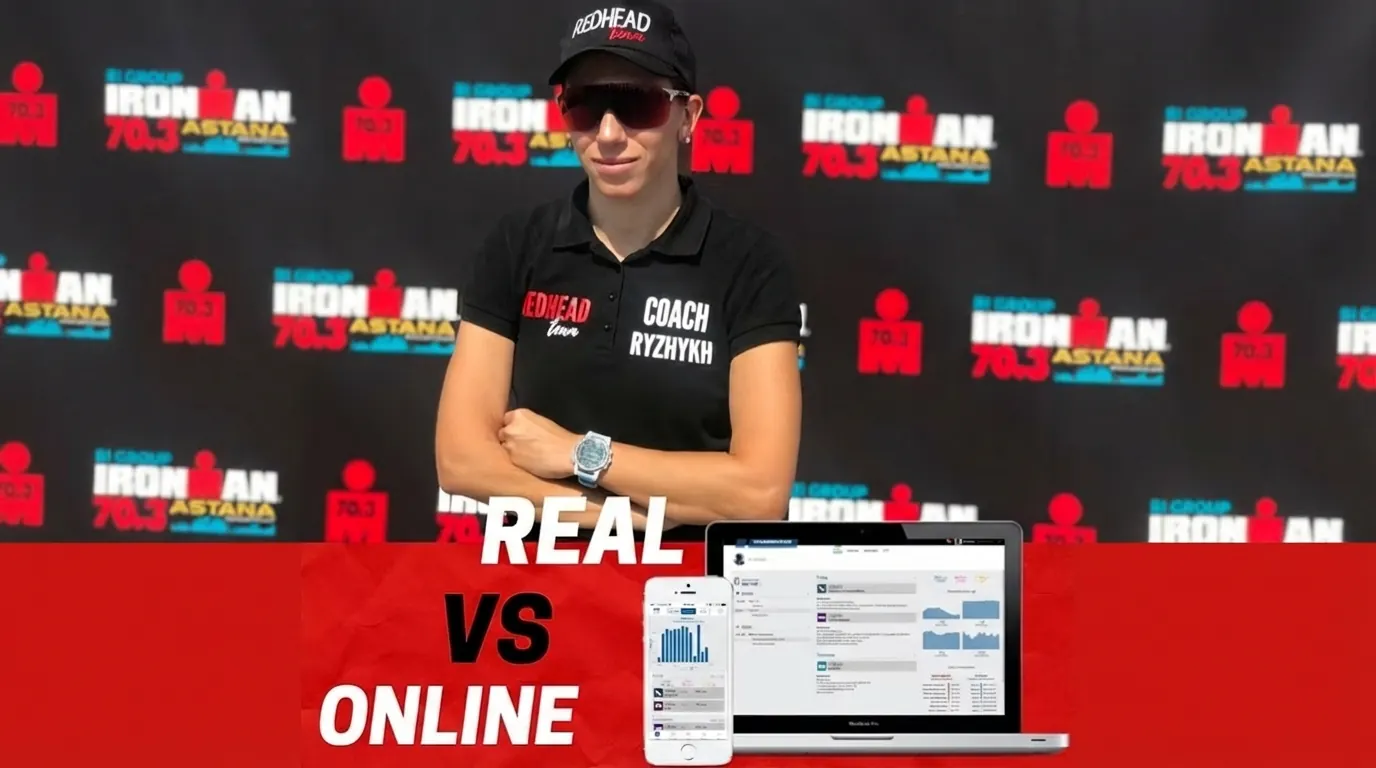
Today I want to talk about online training.
And cover this type of coaching as thoroughly as possible, answering the most pressing questions:
1. Who is it for?
2. Is it effective?
3. Is it worth paying for if you already attend group sessions with a running club three times a week, etc.?
4. What training methodology is the most effective?
Alright, let’s go through it step by step:
Let’s start with the fact that triathlon or running is an individual sport, and an Ironman race means spending 8 to 16 hours alone with your own thoughts.
As you can imagine, your mind needs to be ready for that kind of challenge.
70% of an amateur athlete’s training sessions happen in complete solitude.
This leads to the first and most important factor for successful preparation — the athlete’s motivation.
If you are motivated by your goal, you do not need a coach standing next to you at the track or pool. A clear training plan and subsequent analysis are enough.
Fortunately, the majority of my athletes fall into this category. They live thousands of kilometers away, and thanks to modern technology I can see their workouts as if I were right there.
As soon as an athlete finishes a session, I instantly receive a notification on my phone showing heart rate, pace, cadence, power (if they have a power meter), elevation gain and loss — and if it was an interval workout, the app provides a detailed breakdown of every segment.
Then comes the athlete’s feedback, a comment on the session, and we discuss what went well and where they fell short.
Tell me, is that not incredible?
And I will be honest: even watching an athlete in person at the track, I cannot do that kind of analysis by eye.
The downsides of this approach are the monotony — sooner or later the athlete wants to join a group of like-minded people, where the kilometers fly by and progress comes faster.
It is also quite costly if you cannot swim — you will need an in-person swim coach. Running is easier in this regard: technique can be significantly improved through video recording and analysis in specialized software, followed by recommendations for correcting errors.
What surprised me most was when I compared the rate of progress between my athletes who train exclusively on online plans and those who attend group sessions — the results were virtually identical.
It all comes down to simple training consistency and minimal deviation from the prescribed tasks.
Now about running clubs:
They are a fantastic way to get motivated by the running community, surrounded by fellow "running addicts." The membership fee is usually affordable, which makes running accessible — overall a great starting point for beginners.
But as you can imagine, when there are 30 or more people at a session, you may not get enough individual attention from the coach.
For those who are aiming to prepare for a marathon, I would recommend a structured training plan leading up to race day plus track sessions under a coach’s supervision.
In conclusion, online training is a highly effective preparation method for athletes who already know how to swim, run, and ride — athletes with a high level of motivation who do not need to be pushed or begged to go out in bad weather.
And the most effective training method, in my view, is online coaching through TrainingPeaks with at least 3 supervised sessions per week.