In 20 years of professional sport I've heard this question more than any other. "But your knees! Running will destroy your knees!"
You know what gets me? Science settled this back in 2017. And the answer is the exact opposite of what your mum, your colleague and your neighbour keep telling you.
Look at this. Among people who "protect their knees" on the sofa, arthritis shows up in roughly 10 cases out of 100. Among recreational runners - in 3.5. That's not my opinion or coaching faith. That's data on 114,000 people.
So let's say it again, slowly: who exactly is destroying whose knees?
Short answer: is running bad for your knees?
No. Recreational running is not bad for your knees and it does not "wear down" cartilage. Large studies show the opposite: runners develop knee and hip osteoarthritis about three times less often than sedentary people. Cartilage is fed only through movement, so regular moderate loading makes it thicker and denser. The risk comes not from running itself, but from excess weight, old injuries, sudden jumps in mileage and extreme training without recovery.
Now the details. Where those numbers come from, what actually happens to cartilage, and why knees still hurt if running is so good for them.
Why cartilage doesn't "wear out": the sponge effect
The core mistake is the metaphor. People picture the knee as a car part. A door hinge that inevitably grinds down from friction. Makes sense, right? Use it more, wear it out faster.
Except the body isn't a machine. It's alive and it adapts. And here's where it gets good.
Articular cartilage has no blood vessels. None at all. The only way it gets fed is diffusion from synovial fluid - the lubricant inside the joint.
Now watch how that works in running:
- Stance phase. The foot lands, the load compresses the cartilage, and it squeezes out waste products.
- Flight phase. Pressure drops and the cartilage, like a sponge, draws in fresh fluid loaded with nutrients.
Step after step. Squeeze - absorb. Squeeze - absorb.
Without that cyclical compression, cartilage simply starves. And degrades. So much for the "safe" sofa: it doesn't protect the joint, it cuts off its food supply.
There's a second part. Studies of synovial fluid show that even a 30-minute run measurably lowers the concentration of pro-inflammatory cytokines inside the joint - the molecules that trigger and sustain inflammation. In plain terms: impact loading flushes inflammation markers into the bloodstream and improves the joint's lubrication along the way.
Running doesn't wear the knee down. Running feeds it.
What the research says: 114,000 people and three major studies
I don't like the phrase "scientists have proven". So here are the specifics - who, when, how many people.
JOSPT meta-analysis, 2017. One of the largest studies on the topic, covering data from over 114,000 people. It compared the risk of knee and hip osteoarthritis across three groups:
Recreational running cuts the risk of joint degeneration almost threefold compared with a sedentary life. Problems only appear where there are ultra-high volumes, extreme loads and recovery gets ignored completely.
I'm in that third column, by the way. Twenty years of elite sport isn't about health, it's about results at any cost. And I'll be honest: there is a price. But between "professional sport to the point of breaking" and "three runs a week" lies an abyss. Don't try my column on for size.
Osteoarthritis Initiative (Lo et al., 2017). Researchers analysed people with many years of running history. The conclusion: a history of running is not linked to a higher risk of symptomatic osteoarthritis. In fact, knee pain was recorded less often in runners than in their non-running peers.
Active marathon runners (Ponzio et al., 2018). This one looked at people who had finished at least five marathons and run at least 16 km per week. You'd expect wrecked knees. The opposite showed up: arthritis was significantly less common among them than in the general population.
And the key part is what the study named as risk factors. Age. High body mass index. Old injuries, such as a previous ligament tear.
Mileage is not on that list.
Newer findings: how running repairs knees
If the older statistics simply recorded a fact - runners don't fall apart - the recent work explains the mechanism. And this is where the research got genuinely exciting: the focus shifted from "does running cause harm" to studying its therapeutic effect.
A marathon reduces micro-damage. Researchers took 82 healthy middle-aged adults preparing for their first marathon. They scanned both knees by MRI six months before the start and two weeks after the finish.
On the baseline scans many had asymptomatic micro-damage - bone marrow oedema beneath the cartilage. The person feels nothing, but the MRI shows it. After marathon training and the race itself, that damage had decreased. The condition of the patellar cartilage improved too. And it wasn't a one-off: at follow-up six months later, the improvements held.
Stop. Let's run that again. People ran a marathon, and their knees came out better than before they started training.
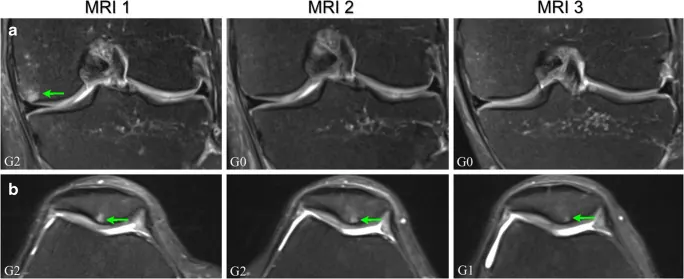
Top row - the femur of a 54-year-old man's left knee: it was G2, after the marathon it became G0, and it stayed that way. Bottom row - the patella of a 48-year-old woman: unchanged right after the race (G2), better six months on (G1).
Source: Horga L.M. et al., Skeletal Radiology, 2020. Published under a CC BY 4.0 licence.
Cartilage gets thicker. Reviews of knee joint structure in long-distance runners show that under regular loading, cartilage tissue produces more proteoglycans - the compounds that hold water and give cartilage its springiness. Cartilage doesn't wear away, it densifies. A natural shield against age-related change.
What actually damages the joint. The TRAIL cohort study, which follows athletes with a history of knee surgery, is ongoing. Recreational running is not identified there as an independent cause of osteoarthritis. The real hit comes from excess weight: in running, the load on the joint exceeds body weight several times over, so every extra kilogram gets multiplied.
So why do knees hurt after running?
Fair question. Because they do hurt. I see it every season in beginners.
The whole "wear and tear" myth survives on one substitution. People confuse two completely different things:
- Cartilage degeneration - that's osteoarthritis. Years, decades, age-related change.
- Overload injury - that's soft tissue. Muscles, ligaments, tendons. Weeks.
The pain a beginner runs into - patellofemoral pain syndrome (around the kneecap) or IT band syndrome (on the outside of the knee) - is almost always the second story. The joint isn't disintegrating. What's around the joint is overloaded.
And here's what I like most about that study: it doesn't hide the inconvenient part. In some participants, oedema appeared after the marathon. These scans:
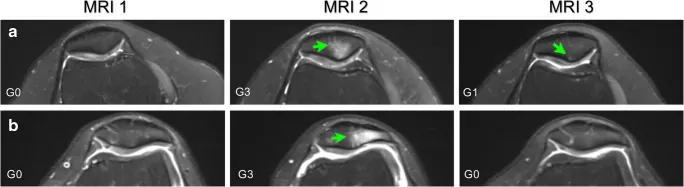
This is the honest picture. Loading really does leave a mark. But a healthy body clears that mark - if you give it time.
Source: Horga L.M. et al., Skeletal Radiology, 2020. Licence: CC BY 4.0.
None of the participants felt a thing. The body sorted it out on its own. Problems start where it isn't given the time - and gets loaded again, and again, and again.
Briefly, the four main causes:
- Progression broken. A sharp jump in volume or intensity. Your heart and lungs adapt faster than ligaments and tendons - that's the trap. Your breathing already lets you run further, but your musculoskeletal system isn't there yet. Muscles stop absorbing impact, and everything lands in the joint.
- Weak stabilisers. Muscle imbalance, weak glutes and a weak core break your running mechanics. The knee starts collapsing inward and the load arrives at the wrong angle.
- Excess weight without a base. Starting to run with a high BMI, skipping general strength work and walking, is the fastest way to find pain and believe the myth.
- Old injuries. A meniscectomy, an ACL reconstruction after contact sport - these permanently change the loading angles in the knee. That's not a ban on running. It's a reason to build the plan differently. And if your injuries keep coming back in a loop - I break down the mechanics in why you keep getting injured running.
Notice what all four have in common? Not one of them is called "running". All four are called "how exactly you run".
How to run so your knees don't hurt: 5 rules
Now the part you probably came here for.
- 1. Build volume slowly. Aim for no more than about 10% more per week, and take every fourth week easy. Boring? Boring. But this is exactly where stubborn, woodpecker-style repetition pays: do it plainly and regularly. It only works that way.
- 2. Run slower than you want to. Keep the bulk of your volume at a low heart rate. It reduces impact loading and gives tissue time to adapt. How to find your pace and zones - I cover that in detail in the article on running by heart rate.
- 3. Strength work isn't optional. Twice a week: glutes, core, feet. Squats, lunges, single-leg bridges, planks. Strong glutes are your knee protection. A weak pelvis leaves the knee alone with the load.
- 4. With excess weight, don't start with running. Walking and general strength work for 4–8 weeks, then short running intervals. Not the other way round. In running, every kilogram is multiplied several times over.
- 5. Recovery is part of the work, not a reward for it. Sleep, food, easy weeks. Tissue rebuilds at rest, not during the session. Training is only the stimulus.
A separate word about pain. A dull ache after unfamiliar loading is one thing. Sharp pain, swelling, pain going down stairs, or pain that doesn't settle for several days - that's a reason to stop tolerating it and stop googling, and to see a doctor instead. Pushing through sharp pain isn't heroic. It's how a small problem turns into surgery.
So you're not guessing whether it's slow enough - enter your result for any distance. The calculator works out your VDOT and shows the safe easy pace your whole base is built on.
Open the calculatorTo sum up
Science has been fairly clear on this one. Running is not the cause of knee wear. The opposite - it's a working way to make cartilage denser, feed it properly and reduce inflammation inside the joint.
Knees aren't destroyed by kilometres. They're destroyed by rushing, excess weight, weak muscles and the habit of never recovering.
Knees don't wear out from running. They wear out from the lack of it.
Frequently asked questions
Is it true that running wears out your knee joints?
Why do beginner runners get knee pain?
Can I start running if I'm overweight?
Can I run after a knee injury or surgery?
Inna Ryzhykh - running and triathlon coach, Master of Sport. Twenty years in professional sport and over ten years of coaching: I prepare athletes and grow amateur triathlon together with the REDHEAD team.
If you need a plan that accounts for your old injuries and current form - see how we can work together or look at my athletes' results.
- Alentorn-Geli E. et al. The Association of Recreational and Competitive Running With Hip and Knee Osteoarthritis — JOSPT, 2017
- Lo G.H. et al. Is There an Association Between a History of Running and Symptomatic Knee Osteoarthritis? — Arthritis Care & Research, 2017
- Ponzio D.Y. et al. Low Prevalence of Hip and Knee Arthritis in Active Marathon Runners — JBJS, 2018
- Horga L.M., Henckel J., Fotiadou A. et al. Is the immediate effect of marathon running on novice runners' knee joints sustained within 6 months after the run? A follow-up 3.0 T MRI study — Skeletal Radiology, 2020;49(8):1221–1229. The MRI images in this article are reproduced from that work under a CC BY 4.0 licence.
This material is for information only and does not replace medical advice. If you have a diagnosed joint condition or the after-effects of an injury, discuss your running load with your own specialist.